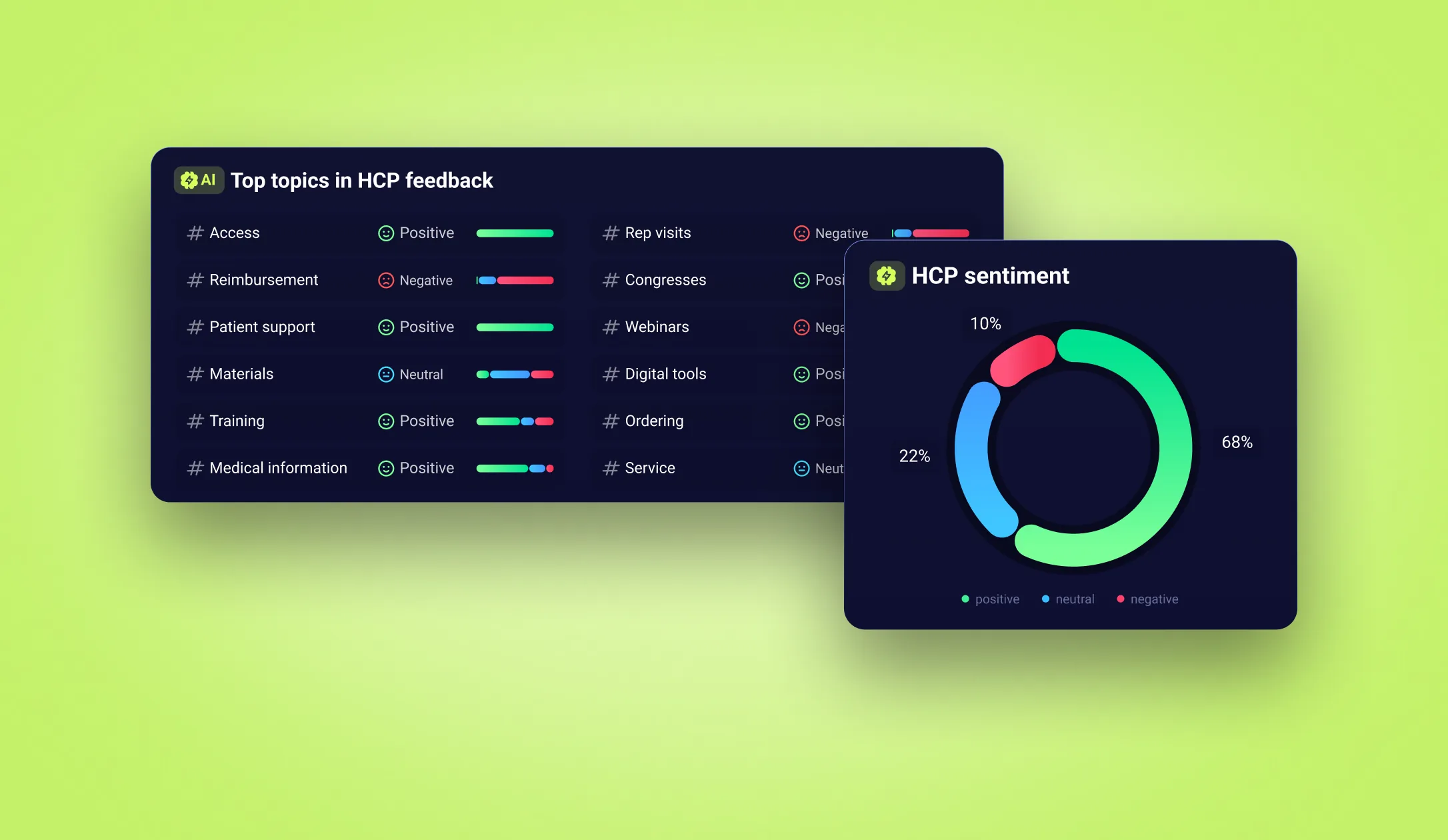
No single tool monitors a pharma product launch on its own. Pharma launch excellence needs five sources read together: prescription and sales data, CRM activity, digital engagement, structured feedback from healthcare professionals (HCPs) and the field, and market research before the launch. The first three show what moved; HCP and field feedback show why – early enough to act.
What does pharma launch excellence actually measure?
Pharma launch excellence measures whether a launch is on track while there is still time to change course. Launch teams usually look at three layers:
- Outcomes – prescriptions, units, market share and access by region.
- Activity – calls, coverage, emails, events and webinars.
- Perception – how HCPs rate the information, the support and the experience around the product.
Pharma commercial analytics covers the first two layers well. The third layer is the one that changes first, and the one most launch dashboards leave out. Perception here means experience and signals – not clinical outcomes. Screver measures what HCPs think of an interaction; it makes no statement about the efficacy of a product.
Which analytics tools cover which part of a launch?
Each tool category covers one part of a launch; none covers all of it. The table shows what each one measures and where it stops.
- Prescription and sales data – Examples: Market data providers, internal sales reporting · What it measures: Uptake, units and share by region and segment · What it cannot see: Why a prescriber started or did not start
- CRM – Examples: Veeva CRM, Salesforce · What it measures: Calls, coverage, frequency, account activity · What it cannot see: Whether the visit was useful to the HCP
- Digital analytics – Examples: Veeva Approved Email, Salesforce Marketing Cloud (SFMC), website analytics · What it measures: Opens, clicks, visits, content use · What it cannot see: What the HCP thought of the content
- HCP and field feedback – Examples: Screver · What it measures: Satisfaction (CSAT), Net Promoter Score (NPS), Customer Effort Score (CES), helpfulness and open comments, by channel, market and product · What it cannot see: Prescription volume – it is read next to the sales data
- Market research – Examples: Pre-launch studies, advisory boards, ad-hoc surveys · What it measures: Needs, expectations, credible messages, a baseline · What it cannot see: Day-to-day change once the launch runs
Where do standard analytics stop seeing anything?
Standard analytics stop at behaviour: they show what HCPs did, not how they felt or what they decided afterwards. MSD describes the gap in exactly these terms. In his keynote in Zurich in June 2025, Stelios Charitakis, Customer Experience Lead for MSD's Mid-Europe region, explained that traditional metrics such as coverage and open rates showed what customers did, not how they felt or what they decided afterwards.
In a launch, that gap matters because outcome data describe what has already happened. A flat uptake curve tells the brand team that something is wrong. It does not say whether the message is unclear, the support material is missing or the access story does not match what HCPs experience.
How do you measure HCP perception before the numbers move?
Ask HCPs a few short questions right after each interaction, in the channels they already use, and read the answers next to the commercial data. In practice that means four things:
- Trigger the survey from the interaction – a rep visit logged in Veeva CRM, an approved email, a congress, a webinar.
- Keep it short and specific – CSAT, NPS or CES, plus one open question.
- Tag every answer by campaign, product and market, so it can sit in the same dashboard as the sales data.
- Read open comments with AI and route safety signals. Screver groups open answers by topic and sentiment, and flags potential adverse events and product quality complaints for the pharmacovigilance team. Screver is a collection and routing layer that feeds the pharmacovigilance system of record; it is not a PV system.
What should you have in place before launch?
Before launch, have a baseline, an agreed question set and approved channels in place, so measurement starts on day one rather than during the launch. A short pharma launch readiness checklist for measurement:
- A baseline from market research – what the audience needs and expects before the product reaches them.
- One set of metrics, templates and reports for every market. MSD agreed this as a regional standard in Q4 2023, including response tagging by campaign and product, before it scaled further.
- Approved forms in every channel. Each new channel needs medical, legal and compliance approval of the form – MSD names this front-end work as part of every channel it added.
- Integration with CRM and dashboards, keyed to the same markets and products as the commercial data.
- An adverse-event and product-complaint process for open text, agreed with pharmacovigilance before the first survey goes out.
- Owners – who reads which result, and what they do with it.
What does this look like in practice?
Three published Screver cases show the method at different scales.
MSD: from a few surveys in Switzerland to a global programme
MSD's Voice of Customer programme started in 2021 with a few surveys in one country, Switzerland. Figures from Stelios Charitakis' keynote, which MSD rounds:
- 2023: more than 15 countries, 200+ users, 250+ surveys, 25,000+ responses
- 2024: almost 40 countries, 300+ users, 500+ surveys, 70,000+ responses
- 2025: MSD started the global roll-out on Screver to close to 70 priority markets
MSD connects CSAT, NPS and Customer Effort Score with business insights. Its channels include Veeva Approved Email, SFMC email, websites, events and webcasts, face-to-face visits and chatbots.
«Start small. One market, one channel, one survey. That's all you need.» – Stelios Charitakis, Customer Experience Lead, Mid-Europe Region, MSD
Organon Biosimilars: feedback after every rep visit
Organon Biosimilars in the US asks physicians about every field visit. After a rep logs a call in Veeva CRM, the physician gets a short Helpfulness Index survey in a Veeva-approved email, with the first question inside the email. The survey covers five dimensions: clarity, relevance, understanding, commitment and customer compassion. The rep and the manager get real-time alerts with a reminder on adverse events and product quality complaints, three dashboards serve reps, managers and HQ, and rep names in open comments are masked automatically.
Lonza: research before and after launch (outside pharma, same method)
Lonza, a Swiss company that develops specialty ingredients and formulations for pharma, biotech and nutrition, used the same approach for IShield, a system that authenticates crop protection products in Brazil. The setup on Screver has two phases: market research before launch plus continuous research after launch. The first phase covers three audiences – distributors, farm decision makers and applicators – in three survey waves around a 14-day product trial. The second phase uses recurring pulse and NPS surveys, satisfaction surveys per audience and drop-out surveys.
What should a launch analytics stack include?
A complete launch analytics stack combines outcome, activity and perception data in one view. Check that yours includes:
- Prescription and sales data for outcomes
- A CRM such as Veeva CRM or Salesforce – for activity, and as the trigger for feedback
- Digital analytics for email and web
- An HCP and field feedback layer that runs in approved channels and is tagged like the commercial data
- AI on open text – topic and sentiment – with adverse events and product quality complaints routed to pharmacovigilance
- Role-based dashboards, for example for reps, managers and HQ
- A pre-launch baseline to compare against
- Hosting your compliance team accepts – Screver data is hosted on Google Cloud in Zurich, Switzerland, with disaster recovery in Frankfurt
Screver is the HCP and field feedback layer in that stack. Developed in Switzerland by the Capptoo Group, it connects with Veeva, Salesforce and SAP, feeds answers into BI tools via the Screver API, and comes with AI Agents such as Product Launch IQ, Topic Detector and the PV Alert Agent. See Product Launch Intelligence and HCP feedback.
Frequently asked questions
What is pharma launch excellence?
Pharma launch excellence is the practice of tracking a launch against its plan – outcomes, field and digital activity, and HCP perception – so the launch team can see why a number moves while there is still time to act.
Which analytics tools are best for pharma product launch analytics?
No single tool. A working setup combines prescription and sales data, a CRM such as Veeva CRM or Salesforce, digital analytics, an HCP and field feedback platform such as Screver, and pre-launch market research. What matters most is that the data are tagged the same way and read together.
What is pharma launch readiness for measurement?
It means having a pre-launch baseline, one set of metrics and reports for all markets, approved survey forms in each channel, CRM and dashboard integration and an adverse-event process for open text in place before launch day.
How do you collect HCP feedback during a launch without compliance problems?
Use approved channels and approved wording, keep surveys short, mask names in open comments, and route any mention of an adverse event or product quality complaint to pharmacovigilance. Organon Biosimilars, for example, reminds reps and managers in every alert how to handle adverse events and product quality complaints.
Is Screver a pharmacovigilance system?
No. Screver is a collection and routing layer: it flags potential adverse events and product quality complaints in feedback and routes them to the pharmacovigilance team, which records them in its own system of record.


