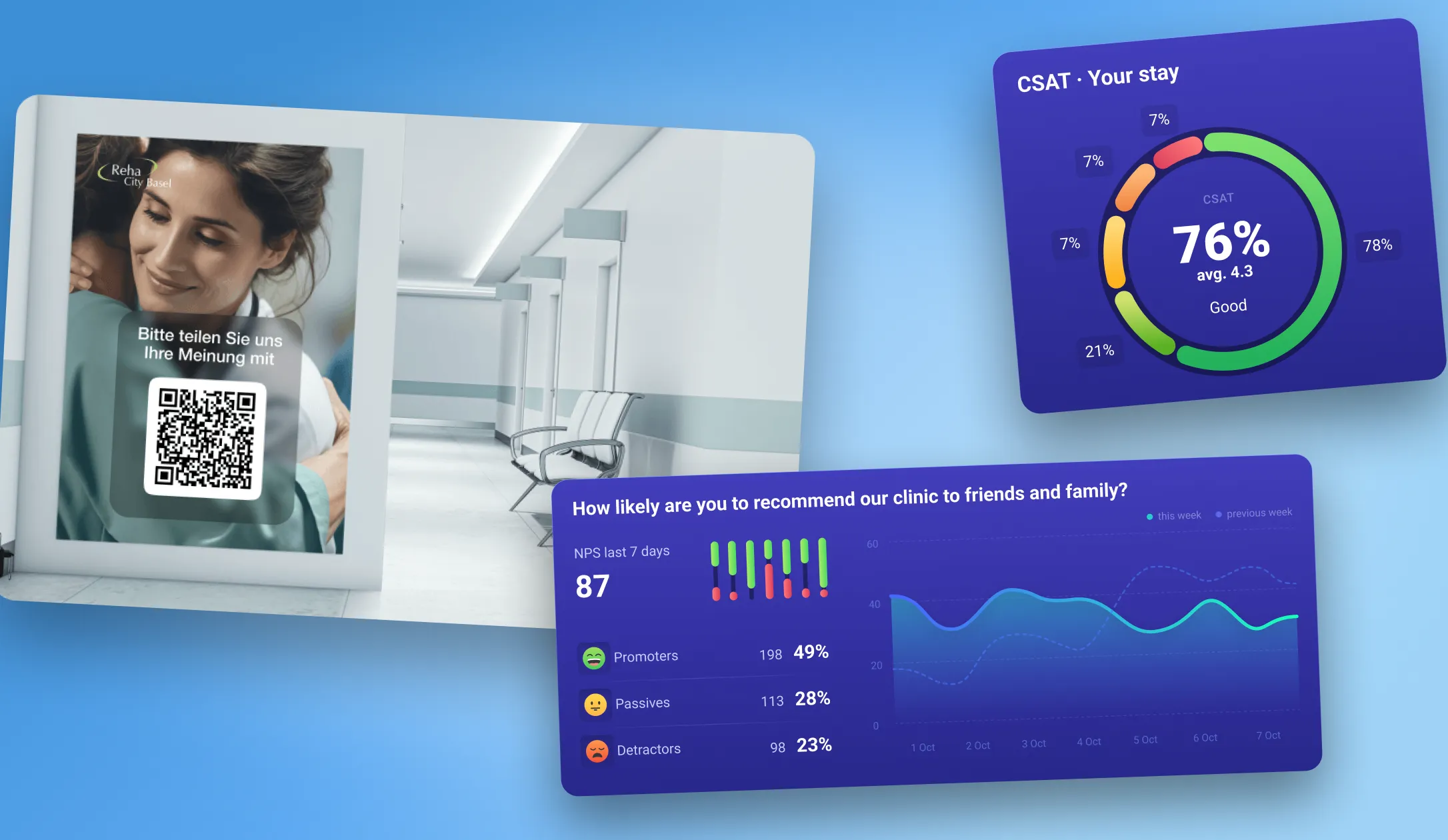
Patient feedback software should let a clinic hear from patients while they are still in treatment, show the results to the teams who can change something, and keep patient data safe. For Swiss clinics, that usually means data hosted in Switzerland. Screver is one such platform: Reha Rheinfelden and Reha City Basel use it to run one always-on patient survey across both centres.
What should patient feedback software actually do?
Patient feedback software should do five things well:
- Collect feedback during the stay. QR codes on posters, tablets in waiting areas or links after an appointment, so patients answer while the experience is fresh.
- Cover several sites in one survey. One survey for a group of clinics, with separate data for each site.
- Show live results to the right teams. Dashboards by site and topic – for example accessibility, scheduling and communication.
- Send issues to the responsible team. A negative comment should reach the person who can act, not only a quarterly report.
- Protect patient data. Hosting, access rights and audit trails that the clinic's data protection officer can approve.
How does it fit with the national ANQ measurement?
In Switzerland, the ANQ coordinates national quality measurements in acute care, rehabilitation and psychiatry, so that hospitals and clinics can be compared nationally (ANQ). In rehabilitation, the 2024 patient satisfaction survey ran in April and May: 15,542 questionnaires were sent, 6,727 patients answered (43.3%), and 368 of them answered online (ANQ infographic 2024). From 2026, the ANQ measures patient experience in rehabilitation with a new, more comprehensive questionnaire (ANQ measurement manual 2026).
The national measurement and an in-house survey do different jobs. The ANQ survey runs in a set period and makes clinics comparable across Switzerland. An always-on survey in the clinic shows what patients experience this week, on which ward and at which site – while there is still time to change something.
When should you ask a patient?
Ask during treatment, not months after discharge. At Reha Rheinfelden and Reha City Basel, patient feedback used to arrive months after discharge, when the experience had faded and valuable details were lost. Teams had no way to adjust care while patients were still there. With an always-on survey, patients now give feedback during their treatment (Reha Rheinfelden case study).
A survey after discharge still has its place – for example on the stay as a whole – but it can no longer change the stay itself.
Which questions should a patient survey ask?
Keep it short: five to eight questions that patients can answer in two or three minutes on their phone. An example structure:
- Overall satisfaction with the stay (CSAT), on a labelled scale.
- Recommendation – “How likely are you to recommend our clinic to friends and family?” (NPS).
- Two or three topics that teams can change – for example accessibility, scheduling and communication, the topics on the Reha Rheinfelden dashboards.
- One open question – “What could we do better?”
- An optional contact request for patients who want the clinic to get back to them.
Ask about the experience, not about diagnoses or treatment details.
How do you collect feedback in a clinic?
- QR posters in corridors, waiting areas and rooms. Reha Rheinfelden and Reha City Basel invite patients this way in both centres.
- Tablets in kiosk mode at reception or in therapy areas, for patients who do not have a phone at hand.
- Links after an appointment by email or SMS.
How do you get more patients to answer?
- Ask where patients wait. Waiting areas, therapy rooms and the cafeteria are better places for a QR poster than the exit.
- Keep it short and plain. Every extra question costs answers.
- Offer the patients' languages. In Swiss clinics that usually means at least German, French, Italian and English.
- Show what changed. When patients see that feedback leads to visible improvements, they are more willing to give it.
How do you keep patient data safe?
For a Swiss clinic, data governance is usually the first question. With Screver:
- Data stays in Switzerland – hosted on Google Cloud in Zurich, with disaster recovery in Frankfurt.
- Role-based access – each team sees only its own site or department.
- Audit trails – changes and access are documented.
- Only what you need – an experience survey does not need diagnoses or treatment details, so do not ask for them.
Screver measures how patients experience their stay. It is not a clinical system and makes no medical assessment. More on compliance and trust at Screver.
What do you do with the results?
Results only matter if a team acts on them. At the two Reha centres, dashboards with custom widgets show live results on accessibility, scheduling and communication, so teams can combine patient care with daily listening. Positive feedback is linked to Google Reviews, so satisfied patients can share their experience with others.
What does this look like in practice?
Reha Rheinfelden and Reha City Basel
- Two rehabilitation centres in Switzerland, with a team of close to 700 people
- One always-on patient survey for both centres, with separate data for each site
- QR posters across both facilities
- Live dashboards on accessibility, scheduling and communication
- Feedback during treatment instead of months after discharge
What about staff feedback in the same clinic?
Many clinics want to hear from their staff as well as their patients, on the same platform. At Klinik St. Katharinental (Spital Thurgau), over 300 of roughly 330 employees took part in the first pulse survey, and short department-based pulses replaced the annual survey (Klinik St. Katharinental case study).
Frequently asked questions
Can patients answer without an app or a login?
Yes. Patients scan a QR code with their own phone and answer the survey in the browser, without an app or a login.
Can one survey cover several clinics?
Yes. Reha Rheinfelden and Reha City Basel run one Screver survey for both centres, and the data for each site stays separate.
Does a Swiss clinic still need the ANQ survey?
Yes. The ANQ measurements are part of the national quality programme for Swiss hospitals and clinics and allow national comparison. A continuous in-house survey with Screver complements them with feedback every week, by site and department.
Where is patient feedback data stored?
With Screver, in Switzerland: on Google Cloud in Zurich, with disaster recovery in Frankfurt. Role-based access and audit trails control and document who sees what.
Does patient feedback replace clinical quality indicators?
No. Patient feedback measures how patients experience their stay – for example accessibility, scheduling and communication. It complements clinical quality indicators; it does not replace them.


